Starting your first year teaching middle school science can feel equal parts exciting and overwhelming. You spend so much time thinking about lesson plans, classroom management, grading, parent communication, labs, supplies, and somehow trying to stay organized through all of it.
If you’re a first year middle school science teacher, I want you to know something right away: you do not have to have everything figured out.
I still remember my first year in the classroom. I wanted every lesson to be perfect. I thought I needed to create every activity from scratch, keep students engaged every second of the day, and somehow magically balance all the responsibilities that come with teaching. Spoiler alert…that’s impossible.
Over time, I learned that the teachers who survive and thrive are not the ones doing the most. They’re the ones finding systems that work, building relationships with students, and giving themselves permission to grow.
If I could go back and talk to myself during that first year, these are the things I would say.
You Don’t Have to Create Everything from Scratch
This is probably the advice I wish someone had drilled into my brain on day one.
As a new teacher, it’s easy to feel like using pre-made resources somehow means you’re not a “good” teacher. That could not be further from the truth.
There are incredible curriculum supports and teaching resources already out there. Use them.
Your energy is much better spent focusing on:
- Building relationships with students
- Learning classroom management
- Improving your delivery of content
- Adjusting lessons based on student needs
- Figuring out what works for your teaching style
Creating every worksheet, slideshow, lab, and activity from scratch is a fast track to burnout.
One of the best things I ever did was stop trying to reinvent the wheel and start adapting quality resources to fit my classroom. It saved me so much time and mental energy.

Stop Creating Everything From Scratch
The Sparks Science Lab gives you access to hundreds of ready-to-use, standards-aligned middle school science resources designed to save you time and keep students engaged. Spend less time planning and more time focusing on what matters most. Teaching.
See What's InsideDon’t Rely Only on the Textbook
Textbooks can absolutely be helpful, but they should not be your only teaching tool.
Middle school students need variety. They need opportunities to interact with content in different ways, especially in science.
If your school allows it, mix in:
- Hands-on activities
- Stations
- Videos
- Interactive notebooks
- Discussion prompts
- Reading passages from multiple sources
- Quick demos
- Collaborative activities
The internet is honestly one of the greatest tools you have as a first year middle school science teacher. There are so many teachers sharing ideas, strategies, and classroom tips online.
Some of my favorite ways to learn from other teachers:
- Following middle school teachers on Instagram or TikTok
- Joining Facebook groups for science teachers
- Watching classroom setup or teaching videos on YouTube
- Connecting with teachers in your school or district
One of the best things I ever did as a teacher was build a community of educators I could learn from. Teaching becomes so much easier when you realize you don’t have to figure everything out on your own.
That’s actually one of the reasons I share classroom ideas, science activities, and teaching tips over on Instagram.
Whether you’re looking for lesson ideas, classroom management tips, or just reassurance that you’re not the only one figuring things out as you go, connecting with other science teachers can make a huge difference.
Engagement Doesn’t Have to be Complicated
I think a lot of new teachers believe every lesson needs to feel like a Pinterest-worthy science lab or an elaborate classroom game.
It doesn’t.
Some of the most effective engagement strategies are actually the simplest.
A few classroom favorites that consistently worked for me:
- Stations
- White boards
- Think-pair-share
- Quick demonstrations
- Partner discussions
- Short videos
- Discussion-based activities
Students really thrive on consistency.
Also, let me say this because I think more teachers need to hear it. Not every lesson is going to be wildly exciting and that’s okay.
Some days are naturally more engaging than others. Some lessons require direct instruction. Some concepts just take more focus and practice.
You’re a teacher. Not a full-time entertainer.
Your classroom doesn’t need to look like a viral social media video every single day in order for students to learn.
Classroom Management is Built on Routines
If there’s one thing that will save your sanity as a first year middle school science teacher, it’s routines.
Middle school students thrive when they know what to expect.
Some routines that have made a huge difference in my classroom:
- Greeting students at the door
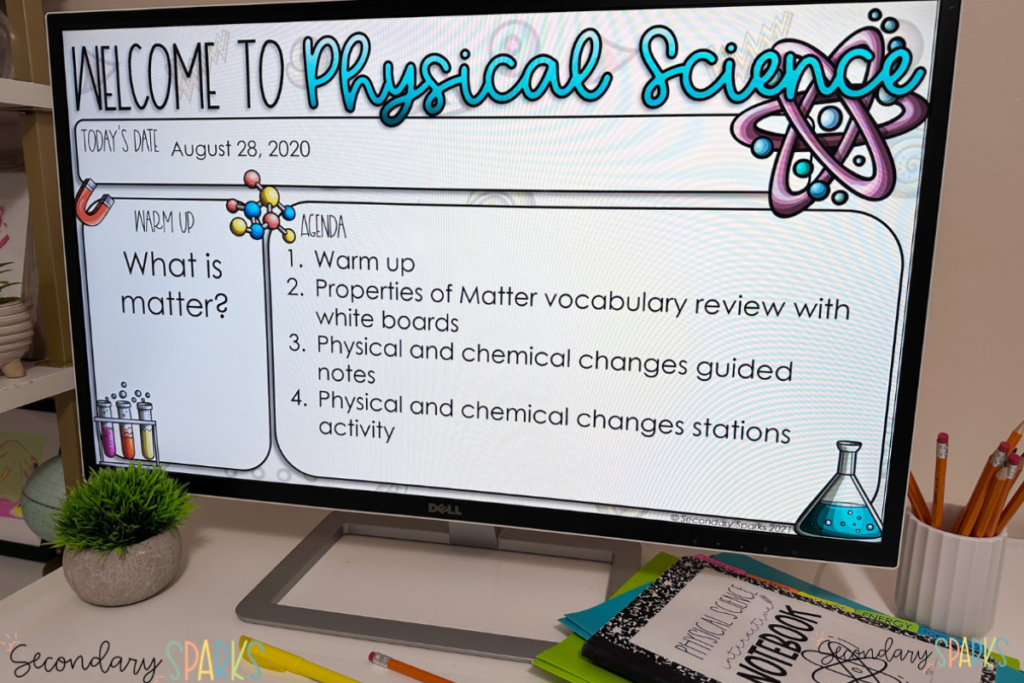
- Displaying a daily agenda slide
- Starting every class with a warm-up
- Having materials ready before students walk in
- Keeping transitions consistent
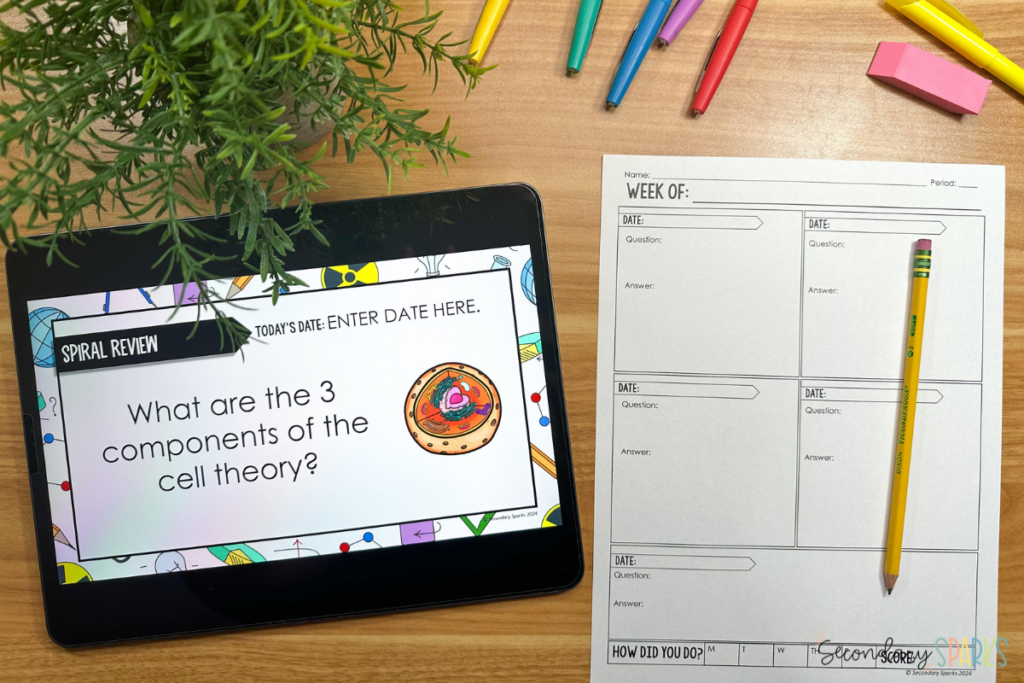
Daily warm-ups became one of my absolute non-negotiables. Not only did they help students settle in quickly, but they also:
- Reinforced science concepts over time
- Reduced behavior issues
- Helped students transition into learning mode
- Gave me time to take attendance and handle quick tasks
Agenda slides were another lifesaver. They helped me stay organized, kept students on track and made it easier for parents to stay informed when I posted them online.
The more predictable your routines are, the smoother your classroom will run.
Interactive Science Notebooks are a Game-Changer
Interactive science notebooks completely changed the way I organized my classroom.
Instead of students having random papers shoved into folders or backpacks, everything stayed in one place.
- Keep learning organized
- Encourage active engagement during a lesson
- Support studying and review
- Give students ownership over their learning
I also loved that students could look back at previous concepts throughout the year. Even if students weren’t in a tested grade level, those notebooks became such a valuable reference tool later on.
Honestly, they even help students when they move into high school science because they still have access to foundational concepts and vocabulary.
For middle school science especially, interactive notebooks are one of those tools that just make everything feel more manageable.
You Don’t Have to Grade Everything
Please hear me on this one. You do not need to grade every single thing students do.
When I first started teaching, I thought every assignment needed a grade in the gradebook. That quickly became overwhelming and honestly unnecessary.
Instead, focus your grading on assignments that truly demonstrate mastery.
Everything else can simply be:
- Practice
- Feedback opportunities
- Class discussion
- Participation
- Self-checking activities
Not only does this save you time, but it creates a more accurate picture of what students actually know and can do.
Completion grades can sometimes inflate or distort student understanding. Prioritizing mastery-based grading helps the gradebook better reflect student learning. And maybe most importantly…it protects your own workload and mental health.
Make Science Relevant
One of the fastest ways to lose student engagement is teaching science in a way that feels disconnected from real life.
Middle school students constantly want to know, “When am I ever going to use this?”
The more you can connect science concepts to:
- Real-world situations
- Student interests
- Everyday life
- Current events
- Careers
- Sports
- Technology
…the more invested students become.
Even small connections make a difference.
Students are naturally curious. Tapping into that curiosity helps science feel meaningful instead of just another class they have to sit through.
Relationships Matter More Than You Think
I’m a firm disbeliever in the whole “don’t smile until Christmas” mentality.
You can absolutely be firm, structured, and consistent while also showing students your personality. Building relationships with students is not a weakness. It’s one of the greatest strengths you can have as a teacher.
Some of the best relationship-building strategies are simple:
- Greeting students daily
- Having quick conversations
- Laughing with students
- Showing interest in their activities
- Letting your personality come through
That does not mean becoming best friends with students or letting boundaries disappear. It simply means creating a classroom environment where students feel respected, welcomed, and comfortable learning.
Students work harder for teachers they feel connected to. And honestly? Teaching becomes a whole lot more enjoyable when relationships are part of your classroom culture.
Not Every Lesson Will Go as Planned
This one is inevitable.
At some point a lab will flop. Technology will fail. Students won’t understand a lesson you thought was crystal clear.
It happens to every teacher. The biggest thing I learned was to stop viewing those moments as failures.
Instead, learn to adjust, reflect, improve, and move forward.
Some of your best teaching growth will come from lessons that didn’t go perfectly. And always, always have a backup plan ready just in case.
If you’re a first year middle school science teacher, give yourself permission to learn as you go.
You’re not supposed to know everything.
The first year is full of trial and error, growth, adjustments, and figuring out what works for you and your students. Some days will feel amazing and some days will feel incredibly hard. That’s normal.
Focus on progress over perfection.
Build routines. Keep things simple. Use the resources available to you. Prioritize relationships. And remember that great teaching is something you develop over time, not something you magically master in year one.
You’re doing better than you think.
Leave a Reply