
Description
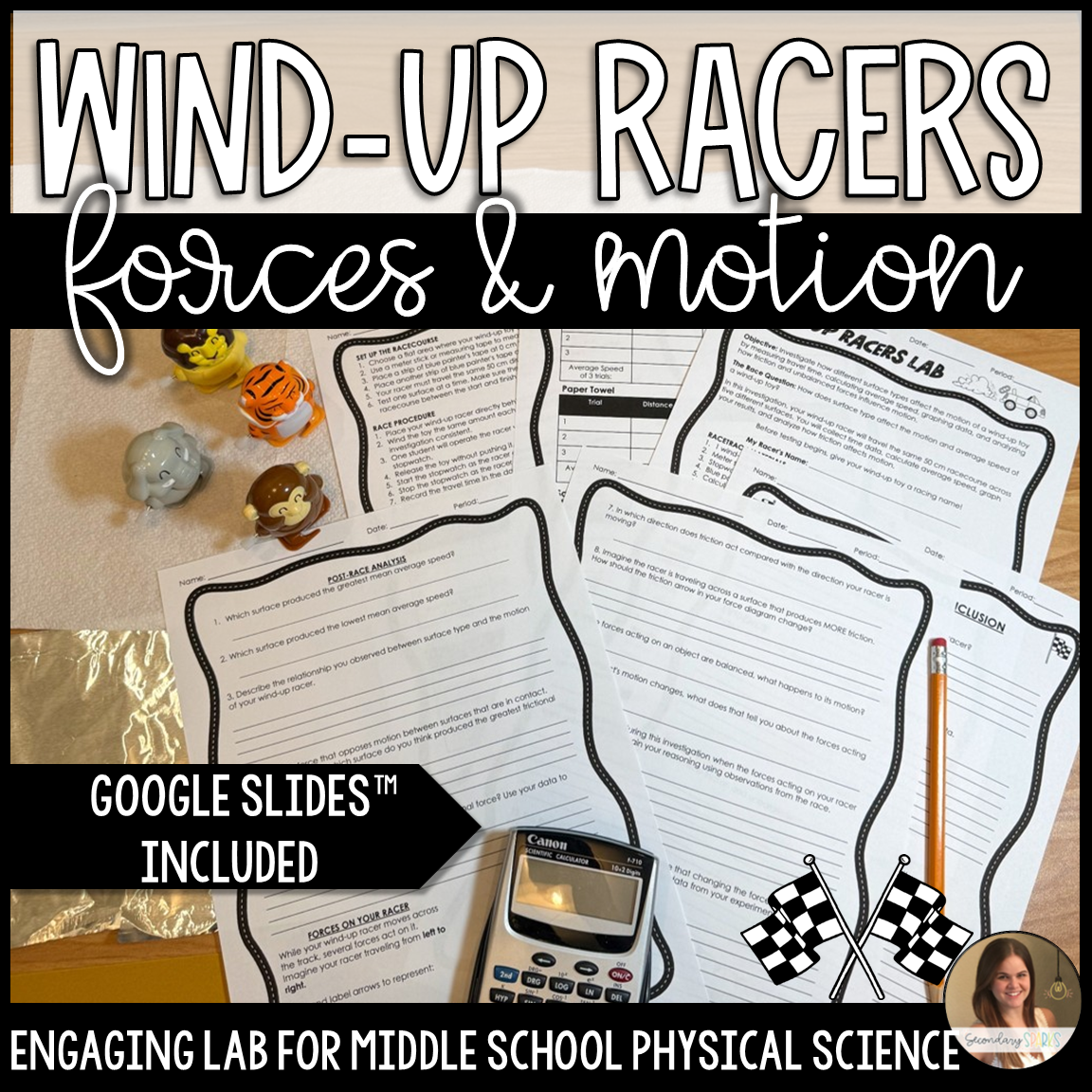
Bring forces and motion to life with this fun, hands-on Wind-Up Racers Lab designed for middle school science and physical science students!
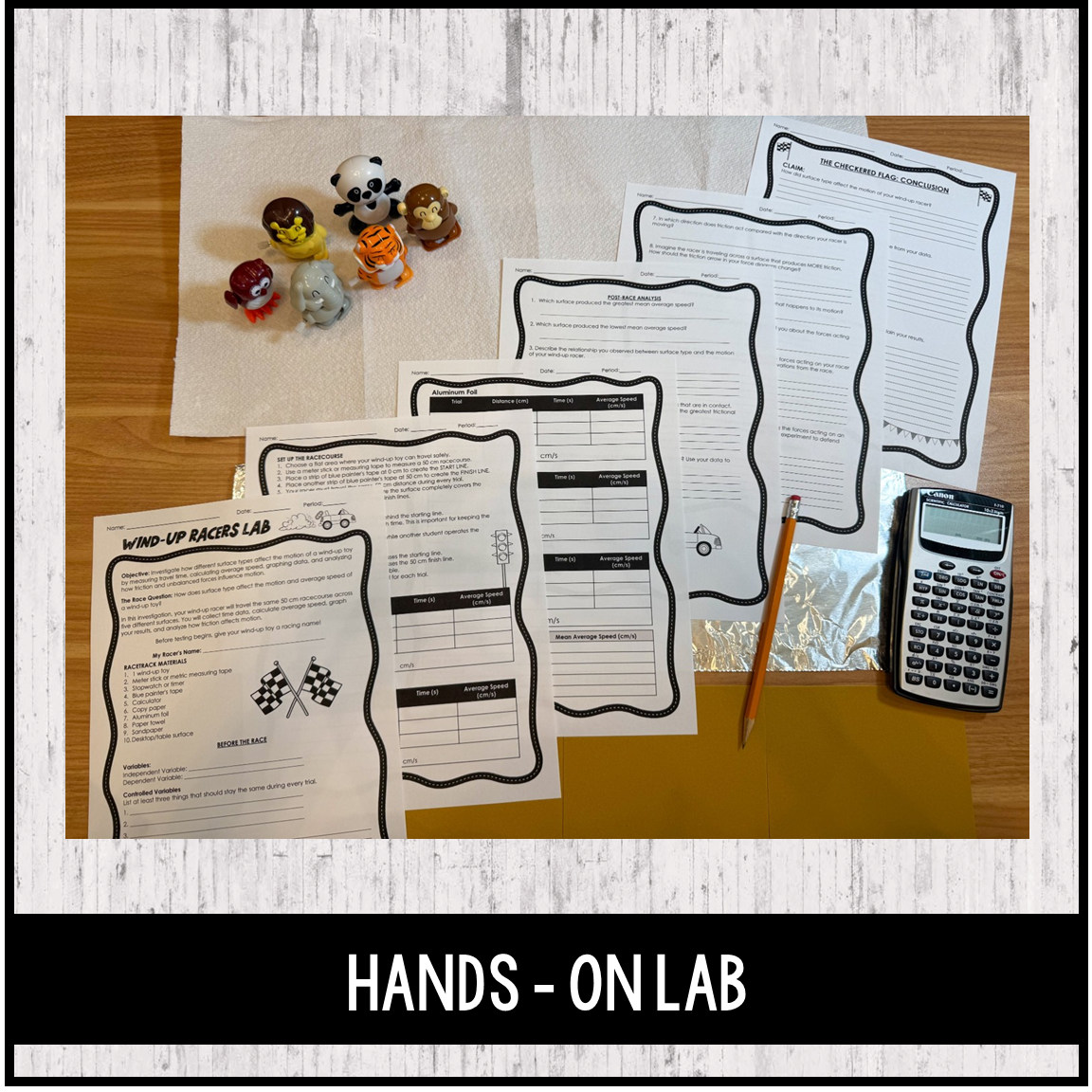
In this engaging investigation, students turn ordinary wind-up toys into race cars as they explore how different surface types affect motion. They’ll design a 50 cm racetrack, race their toys across five different surfaces, calculate average speed, analyze friction, identify forces, and use experimental evidence to explain their results.
This racing-themed science lab combines mathematical practice, scientific inquiry, graphing, and Newton’s Laws into one memorable activity. It’s an excellent addition to your forces and motion unit and a fun way to get students actively involved in collecting and analyzing real experimental data.
What’s included?
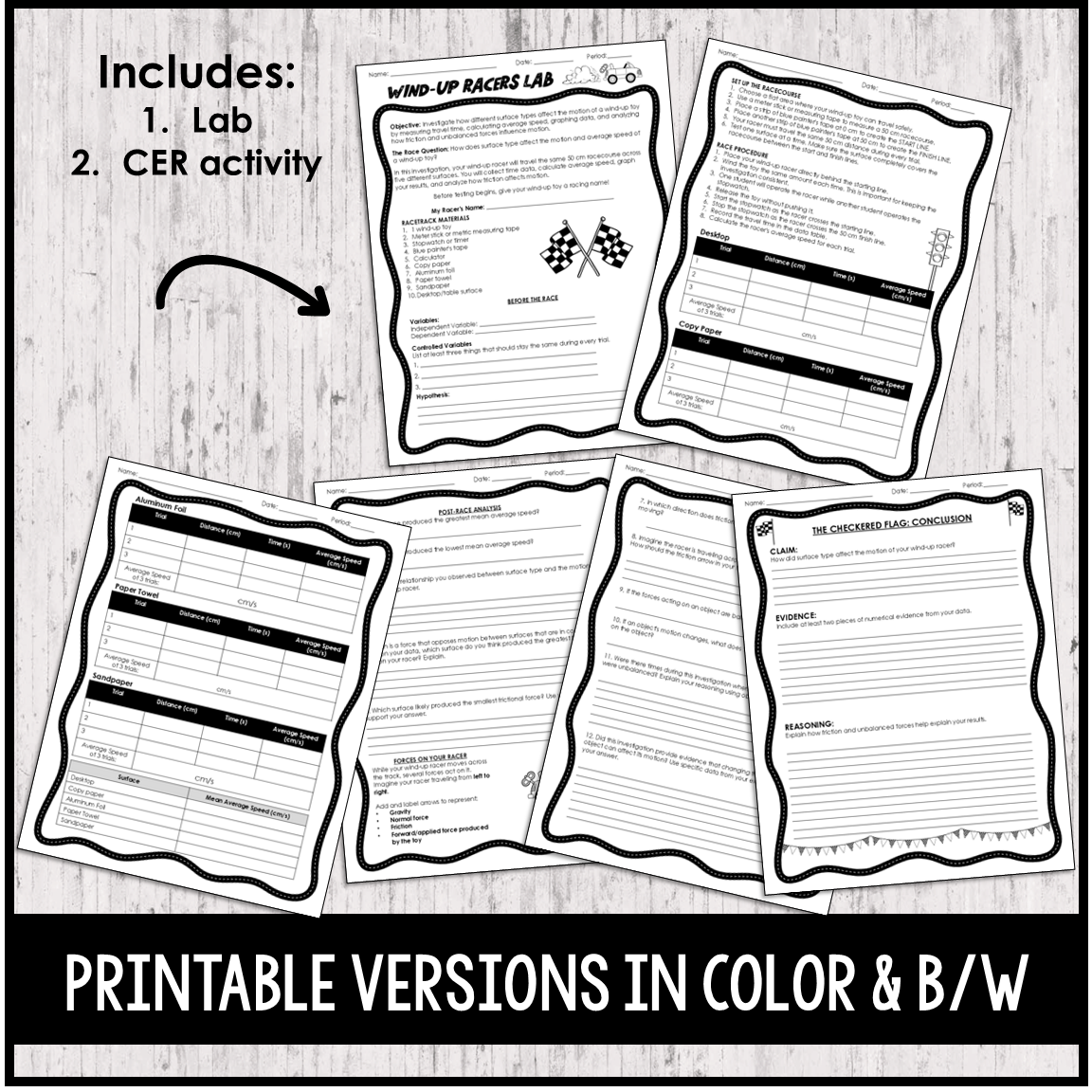
- Printable, ready-to-use student lab worksheets
- Editable version for easy classroom customization
- Google Slides version for digital use
- Teacher instructions and setup tips
- Possible answer key for post-lab analysis
- Racing-themed data tables, force diagrams, and CER conclusion
What will students do?
Students begin by naming their wind-up racer, identifying experimental variables, and developing a hypothesis. Using blue painter’s tape, they’ll create a 50 cm racetrack and test their toy on five different surfaces: desktop, copy paper, aluminum foil, paper towel, and sandpaper.
Students will complete three trials on each surface, for a total of 15 races.
Throughout the investigation, they’ll:
- Measure travel time and calculate average speed using the distance ÷ time formula.
- Calculate the mean average speed for each surface.
- Organize and compare experimental data.
- Graph their results to visualize how surface type affects speed.
- Identify gravity, normal force, friction, and the forward force acting on their racer.
- Explain the relationship between balanced and unbalanced forces and changes in motion.
- Complete post-race analysis questions and a claim-evidence-reasoning (CER) conclusion supported by numerical data.
The lab encourages students to think beyond simply identifying which racer is fastest. They’ll investigate how the interaction between the wheels and different surfaces affects motion and use their findings to support scientific explanations.
Easy to prep and classroom-friendly
No expensive lab equipment required! Most materials are inexpensive and can already be found in a typical science classroom. Students can work in small groups, making this a great collaborative investigation.
The printable pages are also a perfect addition to a science interactive notebook. Students can keep their experimental data, calculations, force diagrams, and written conclusions together as a reference throughout their forces and motion unit.
Standards alignment
This lab supports the following middle school science standards:
Florida Standards
- SC.6.P.13.3 – Investigate and describe how unbalanced forces change an object’s motion.
- SC.6.P.12.1 – Measure and graph distance and time to determine the speed of an object. (Partial alignment; distance-time graphing is not included.)
TEKS
– 7.7(A) – Calculate average speed using distance and time measurements from investigations.
NGSS
– MS-PS2-2 – Plan an investigation to provide evidence that the change in an object’s motion depends on the sum of the forces on the object and the mass of the object. (Partial alignment; mass is not investigated.)
Perfect for
Middle school science, physical science, forces and motion units, average speed practice, friction investigations, Newton’s Laws review, collaborative lab activities, and interactive science notebooks.
Reviews
There are no reviews yet.