

Description
This cell theory unit bundle is perfect for middle school science! This Cell theory and cell characteristics unit bundle is perfect for reviewing topics such components of cell theory, prokaryotic vs eukaryotic cells, levels of organization and more. This bundle is great for a life science or biology class. The bundle contains a PowerPoint Lesson, Guided Notes, Assessment, self-grading task cards, choice board, warm ups, stations activities, print activities and digital interactive lessons that can all be used with Google slides or Google forms!
Content covered:
⭐Vocabulary (Species, Archaea, Bacteria, Protista, Plantae, Animalia, Domain, Eukarya, Fungi)
⭐Carlous Linnaeus
⭐Binomial nomenclature
⭐Scientific names
⭐ Levels of classification: domain, kingdom, phylum, class, order, family, genus, species)
⭐ Characteristics of Eukarya, Bacteria and Archaea
⭐Organisms that belong in Domain Eukarya. Organizing by Kingdom: Protista, Fungi, Plantae and Animalia
Included in the Bundle:
1. PowerPoint Lesson, Guided Notes and Assessment
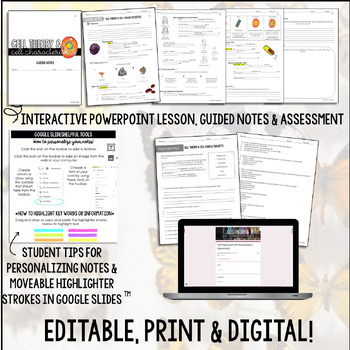
Do you need a resource to introduce Cell Theory and Characteristics of Prokaryotes and Eukaryotes to your life science or biology class? This resource contains a PowerPoint lesson with Cornell notes style guided notes and an assessment that all tie together. This resource is excellent for traditional and digital interactive science notebooks. The PowerPoint and guided notes are also included in Google Slides which make this a perfect digital resource for online learning! There is also a self-grading Google Forms assessment. This is a no prep resource!
The PowerPoint Lesson and guided notes are broken up into 4 different parts:
❔ Engage: This is a question that is used to get students thinking and engaged before the lesson begins. They answer the question in their guided notes.
☑ Checkpoints: These are questions throughout the lesson that assess what students are learning as they go through. The student’s answer these questions in their guided notes. Answer key is included in the PowerPoint.
↵ Bringing it Back: This final question wraps up the lesson by tying student’s new knowledge with the engagement piece.
✐Summarize! Students can summarize their learning by writing, drawing or both.
All links for the Google Slides and Google Forms are included in the resource.
The PowerPoint is editable. The titles, images and clip art are not editable.
Guided Notes:
The Cornell style guided notes follow along with the lesson. This allows the students to go through the lesson with the class as the teacher goes through the slides or they can fill it out independently if they are using the PowerPoint digitally. All the text aside from the title and cover page are editable.
Includes two cover pages for interactive notebook booklets. One in color and one in black and white.
The Google Slides version of the notes includes text boxes for students to add in their own text. A Google Slides “toolbox” is included for students to reference to for changing fonts, adding images, drawings, etc. There are even drag and drop highlighter marks for students to make their notes more interactive.
*There is an included answer key for the guided notes to be easily printed and added to a teacher’s copy of an interactive science notebook.
Assessment:
The assessment contains 20 questions with a mix of vocabulary matching, short answer and multiple choice questions. An answer key is included. Everything is editable except for the title and any included clip art lip art.
A Google Slides version is included as well as a self-grading Google Forms version. The links are included in the resource.
2. Task Cards
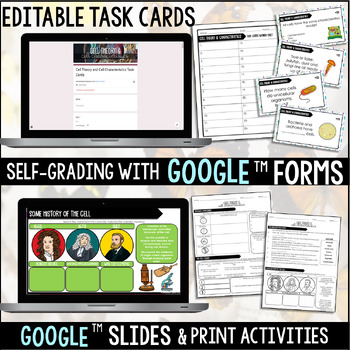
These 24 Cell Theory and Cell Characteristics task cards can be used in a classroom or digitally for distance learning through Google Forms with no prep. They are editable and even self-grading! Perfect for a Life Science or Biology class. They can be easily printed, cut and laminated for use in the classroom with a ready-to-print student answer sheet.
Review vocabulary and key concepts related to cell theory, Prokaryotic vs eukaryotic cells and levels of organization. The link for Google Forms is available in the resource. An answer key is included in the resource and in Google Forms.
Task cards can be printed 1 per page or 4 per page. The answer sheet can be printed 1 per page or 2 per page to save paper. I typically print 2 per page so they’re perfect for gluing into interactive notebooks.
*Please note that the text is editable in each task card but the titles and clip art are not editable.
3. Warm-Ups
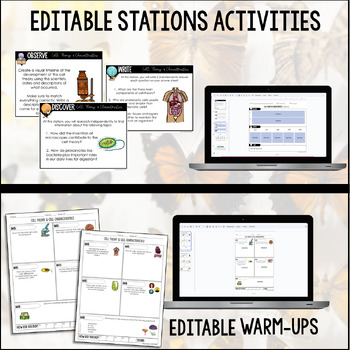
2 weeks of editable cell characteristics warm ups about cell theory, prokaryotic vs eukaryotic cells and levels of organization. These could also be used as exit tickets! Digital or print versions are perfect for a Cell Theory unit in your Life Science or Biology class with no prep! Use these as bellringers to get your students ready for the day or end the class with a ticket out the door. Google Slides versions are also included for online learning!
Each question is in short or long response format so students explain the topic and show their understanding.
There are 3 ways to use these editable warm ups/exit tickets:
1. Use them with slides as students fill out the answers on their own personal answer sheet.
2. Use the answer sheets with the questions on them without the slides. I personally have my students hole punch them each week to add into a pronged folder or binder to use as a study tool. You can even print them at 90% so students can glue them into their interactive science notebooks!
3. Use them for online learning or digitally with the Google Slides version. This is also perfect for digital interactive student notebooks.
A PowerPoint version is included for editing and a PDF version is included for easy printing.
*The questions are editable but the fonts and clip art are not due to copyright.*
Included in this resource:
✅ 2 weeks of warm ups/exit tickets (10 total).
✅ 3 editable templates to fit the needs of you and your students
✅ PowerPoint Slides with the questions to project for your students
✅ Answer key
4. Stations
Do you need differentiated Cell Theory and Characteristics of Cells stations activities for your Cells unit? Perfect for a middle school Life science class. This resource will help you reach and assess your students in a multitude of ways. This resource includes 7 stations with minimal prep involved. There is a printable version, editable PowerPoint version and a Digital Google Slides™ version that will help you save on time and paper!
The 7 types of Cell Characteristics and Cell Theory stations include:
1. Discover – Students will research real-world application of cell theory.
2. Observe – Students will observe and create a visual timeline of cell theory.
3. Experiment – Students will use a microscope to identify cells vs nonliving things.
4. Write – Students will explain their answers to questions in 2-3 sentences.
5. Create – Students will create an infographic for their peers about levels of organization.
6. Sort – Students will sort characteristics of prokaryotic cells and eukaryotic cells.
7. Quiz – Students will answer a mix of 8 true/false, multiple choice and short answer questions.
*Each station should take students between 8-10 minutes to complete.*
This resource includes:
- Digital Google Slides™ link to perform stations online.
- Printable version of stations in color and black/white
- Editable PowerPoint version of stations.
5. Google Slides/Print Activities
This is a print and digital interactive science notebook resource that uses Google Slides. There are 6 interactive cells activities related to the cell theory and characteristics of prokaryotes and eukaryotes. These activities are perfect for a Life Science or middle school biology class with no prep! Perfect for online learning!
Use these activities for:
- Sub Plans
- Test Prep (Florida SSA, Texas STAAR, NGSS)
- Online Learning
- Homework
- Independent review
- Stations
- Interactive Notebook Activity
Students will practice vocabulary skills, make real-world connections, research independently, understand visual representations and review concepts.
The activities include either drag and drop or short answer text. Watch the preview video to get a better idea of how each slide works.
The slides and print version are not editable. An answer key is included in the PDF as well as the Google Slides link.
6. Choice Board
This cells choice activities menu allows students to choose a cell theory project of their choice. The differentiation of activities provides students with autonomy in their learning and presentation of knowledge. The project will assess knowledge of cell characteristics, levels of organization, cell theory and prokaryotic vs eukaryotic cells. Perfect for an Middle school Life Science or Biology class.
Included in this resource:
✅ 1 editable choice board with 9 activities to choose from.
✅ 1 editable rubric.
✅ 1 color and 1 black/white version for printing.
✅ Editable PowerPoint file for editing
✅ PDF file for printing
✅ Link to Google Slides version for Google Classroom
This choice board is editable to suit the needs of you and your students. Students can also submit most of the activities digitally through Google Classroom or Canvas.
General teacher directions and the choice board are included in PowerPoint format for easy editing. There are no rubrics included within the resource for their individual choice activities, only one rubric that can work for any of the project choice.
*Only the choice options are editable. Fonts and clip art are not editable due to copyright.
A few of the options included in the choice board:
✅ Film a fictional news story
✅ Writing a song about
✅ Creating 3D models
✅ Creating a flipbook
✅ and more!
Related Blog Post: Tips for Teaching Cells in Middle School Science
Reviews
There are no reviews yet.