Every teacher has experienced this, right?
You’re explaining an important concept when a student raises their hand and says, “Can I go to the bathroom?”
Before that student even reaches the door, another needs the nurse. Someone else forgot their Chromebook in another classroom. And another student wants to stop by the media center.
Suddenly, you’re directing hallway traffic instead of teaching.
If you’ve been searching for hall pass ideas for middle school, you’re probably looking for a way to keep students moving without turning every request into a classroom interruption.
The challenge is that student needs don’t stop just because class is in session. Students need to use the restroom, visit the nurse, make up work, and occasionally handle things outside of your classroom. A good hall pass system makes those everyday situations feel manageable instead of disruptive.
After plenty of trial and error, I’ve found that the most effective systems have less to do with the actual pass and more to do with how the process works from start to finish. Here are a few things worth considering before you print, laminate, or purchase anything.
The Best Hall Pass Ideas for Middle School Aren't Really About the Passes
When teachers start looking for new hall pass systems, it’s easy to get distracted by the materials. Maybe you’ve seen classrooms with beautifully laminated passes. Or maybe you’ve considered color-coded passes for different destinations.
I’ve been there too.
The problem is that none of those things solve the actual issue. A laminated pass won’t help if students aren’t sure when they’re allowed to leave. Color coding won’t matter if nobody knows where the passes belong. A fancy sign-out system won’t work if expectations change every day.
The most effective hall pass ideas for middle school focus on creating predictable routines. Students should know exactly what happens when they need to leave the room. They shouldn’t have to guess and you shouldn’t have to explain it repeatedly.
The less mental energy everyone spends figuring out the procedure, the smoother your classroom runs.
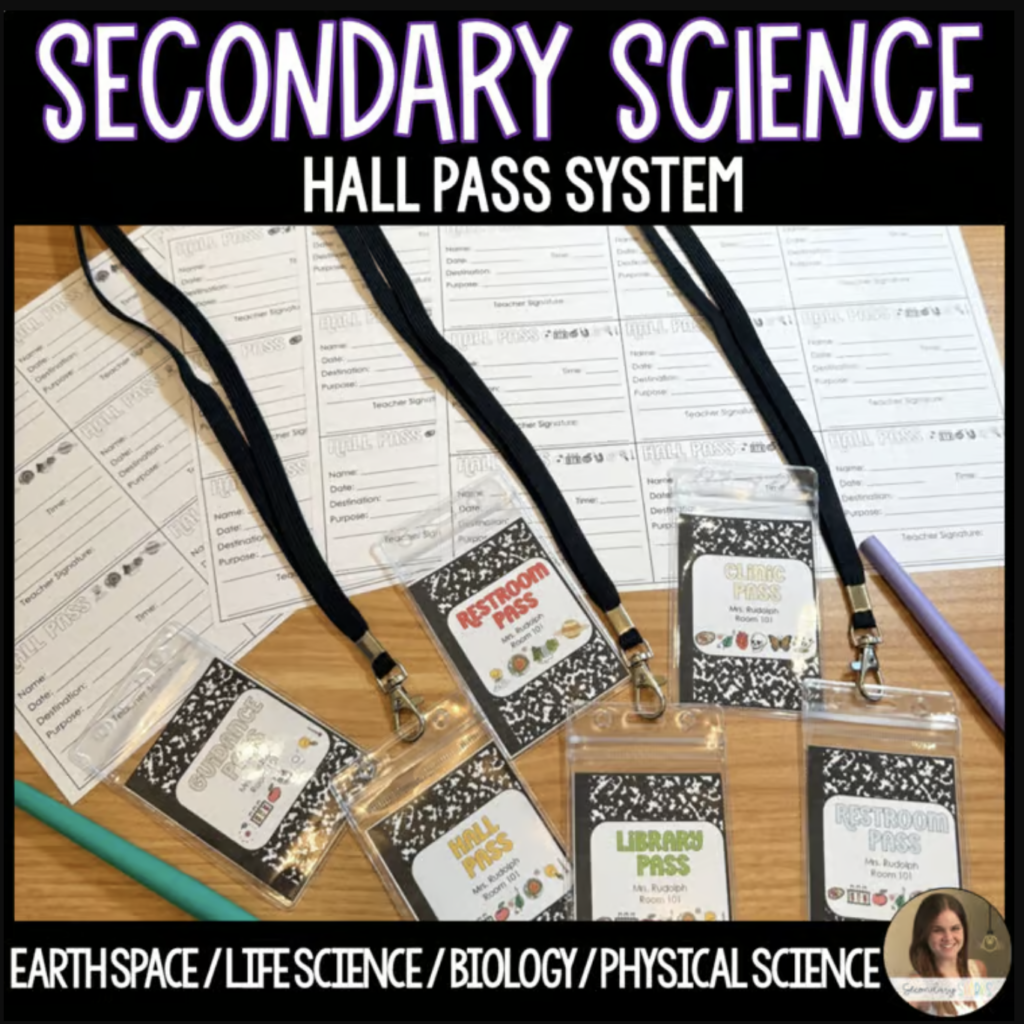
Tired of Managing Hallway Traffic During Class?
This editable science classroom pass system gives students a clear process to follow so you can spend less time answering requests and more time teaching.
See the Science Hall Pass SystemDecide Your Classroom Philosophy First
Before choosing a hall pass system, decide what makes sense for your classroom. This is where I think a lot of classroom management advice misses the mark.
Too often, teachers are told there’s one “right” way to handle things.
There isn’t!
Some teachers prefer students to ask permission every time they leave the room. Others are comfortable allowing students to leave independently as long as they follow established procedures.
Both approaches can work beautifully.
The important thing is choosing a system that fits your teaching style, your students, and your classroom environment while still maintaining safety and accountability.
Questions to consider:
Ask yourself:
- Do I want students to request permission before leaving?
- Are students generally responsible and independent?
- During what activities am I comfortable allowing students to leave?
- What procedures will make me feel confident that students are safe?
Once you’ve answered those questions, choosing a system becomes much easier.
Hall Pass Ideas for Middle School Classrooms
There are countless variations, but most effective systems fall into one of these two categories.
Option 1: Independent Pass System
With this system, students:
- Grab a pass
- Sign out
- Leave quietly
- Return the pass when they come back
Students don’t need to interrupt instruction every time they need to leave. This approach works especially well during:
- Independent work time
- Stations
- Review activities
- Group projects
- Hands-on science labs
For example, if students are working through a station rotation or completing a review activity before a unit assessment, stopping instruction every few minutes to grant permission can become distracting. An independent system keeps things moving.
Benefits of an Independent Pass System:
- Fewer classroom interruptions
- Encourages student responsibility
- Allows instruction to continue uninterrupted
- Saves teacher energy throughout the day
- Helps students learn independence
Of course, this system only works if expectations are crystal clear. Students need to know when it’s appropriate to leave and when they should wait.
Option 2: Ask First System
In an Ask First System, students request permission before leaving and the teacher decides whether the timing is appropriate.
This approach often works best during:
- Direct instruction
- Safety demonstrations
- Assessments
- Classroom discussions
- Lab procedures
As science teachers, we’ve all had moments when stopping a student from leaving wasn’t about control, it was about safety.
If you’re demonstrating lab equipment, reviewing safety procedures, or giving critical instructions before an experiment, having students wait a few minutes may be necessary.
Benefits of an Ask First System:
- Greater teacher awareness
- Easier to monitor timing
- Helpful during safety-sensitive activities
- Allows flexibility based on classroom needs
Neither system is inherently better. The teachers I know with the strongest classroom management use both approaches depending on the situation.
What matters most is consistency. Students should know exactly what to expect every day.
3 Things Every Effective Hall Pass System Needs
Regardless of which system you choose, every successful hall pass routine includes three key pieces.
1. A Visible Hall Pass
The first requirement is simple. Students need something visible that immediately communicates they have permission to be in the hallway.
This could be:
- A lanyard
- A clipboard
- A badge holder
- A laminated pass
- A designated object
In my classroom, I like passes that are easy to spot from a distance.
Science teachers can have a little fun with this too. I’ve seen teachers use:
- Beaker-shaped passes
- “Lab Pass” lanyards
- Science-themed badge inserts
- Colorful STEM designs
The design isn’t what makes the system effective, but having a visible pass helps everyone quickly recognize that the student has permission to be out of the room.
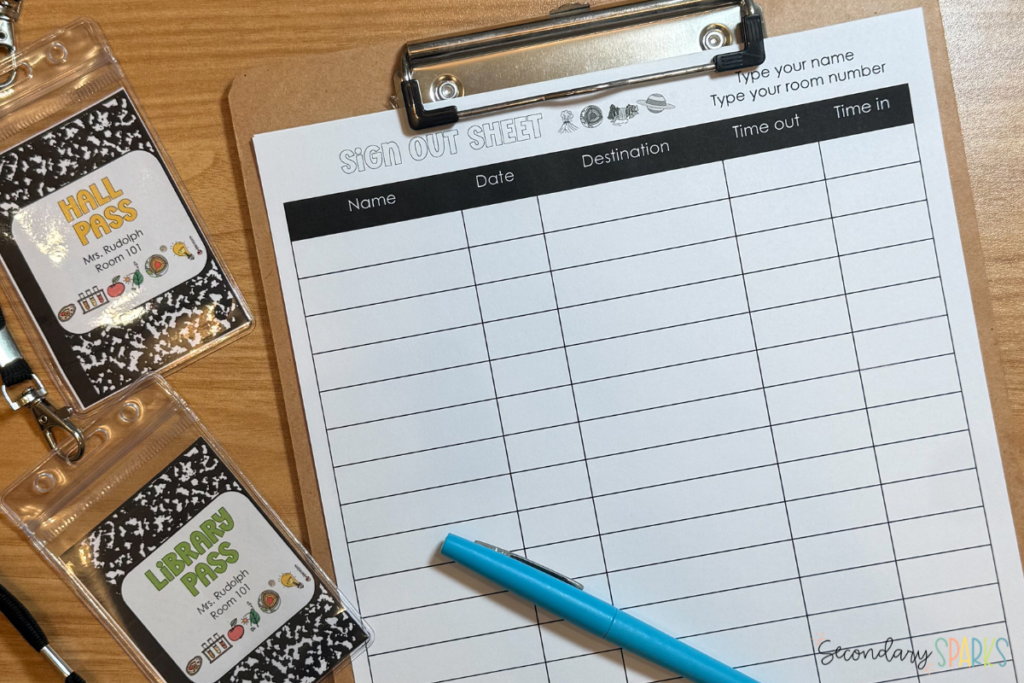
2. A Sign-Out Sheet
If I could only recommend one thing, it would be this. Use a sign-out sheet. Every single time.
A sign-out sheet helps with:
- Fire drills
- Lockdowns
- Medical emergencies
- Substitute teacher coverage
- Accountability
- Identifying patterns
When students leave, they should record:
- Their name
- Time out
- Destination
- Time back
Hopefully, you’ll never need that information. However, if there’s an emergency or a student doesn’t return when expected, having documentation becomes incredibly valuable.
I’ve also found sign-out sheets useful for identifying trends. If a student consistently leaves during a certain class period or routinely spends long periods out of class, you’ll have documentation that can help guide future conversations.
They’re also a lifesaver for substitute teachers. Instead of inventing procedures on the spot, substitutes can simply follow the system your students already know.
3. Clear Student Expectations
This is where many hall pass systems succeed…or fail.
Students need explicit instructions about:
- When they can leave
- How many students can be out at one time
- Where passes belong
- How to sign out
- Expected behavior in the hallway
- What happens if procedures aren’t followed
Never assume students know the routine simply because it seems obvious.
Take time to model it.
Practice it.
Revisit it when needed.
The more predictable the process becomes, the fewer reminders you’ll need to give throughout the year.
Common Hall Pass Mistakes That Create More Problems Than Solutions
Interestingly, most hall pass problems aren’t caused by students. They’re caused by unclear systems.
Here are some of the most common mistakes I see.
No Sign-Out Sheet
Without documentation, it’s difficult to know who left, when they left, or where they went.
Different Rules Every Day
Students struggle when expectations constantly change.
If they’re allowed to leave independently on Monday but need permission on Tuesday, confusion is inevitable.
Students Don't Know the Expectations
A procedure that lives only in your head isn’t really a procedure.
Students need to be taught exactly what to do.
No Designated Place for Passes
When students don’t know where passes belong, you’ll spend unnecessary time answering questions and searching for missing materials.
Too Many Students Out at Once
Even the most independent classrooms need boundaries.
Limiting the number of students out at one time helps maintain accountability.
Replacing Procedures with Constant Reminders
If you’re repeating the same directions every day, it may be a sign that the procedure itself needs to be clarified or reinforced.
Notice that most of these problems aren’t really about the pass itself. They’re usually the result of inconsistent routines or unclear expectations.
A Simple Hall Pass Upgrade I've Been Loving This Year
Can we talk about laminated passes for a minute? Last year, I spent time laminating classroom passes and within a couple of weeks they already looked awful.
The edges peeled. Students bent them. Some somehow disappeared entirely.
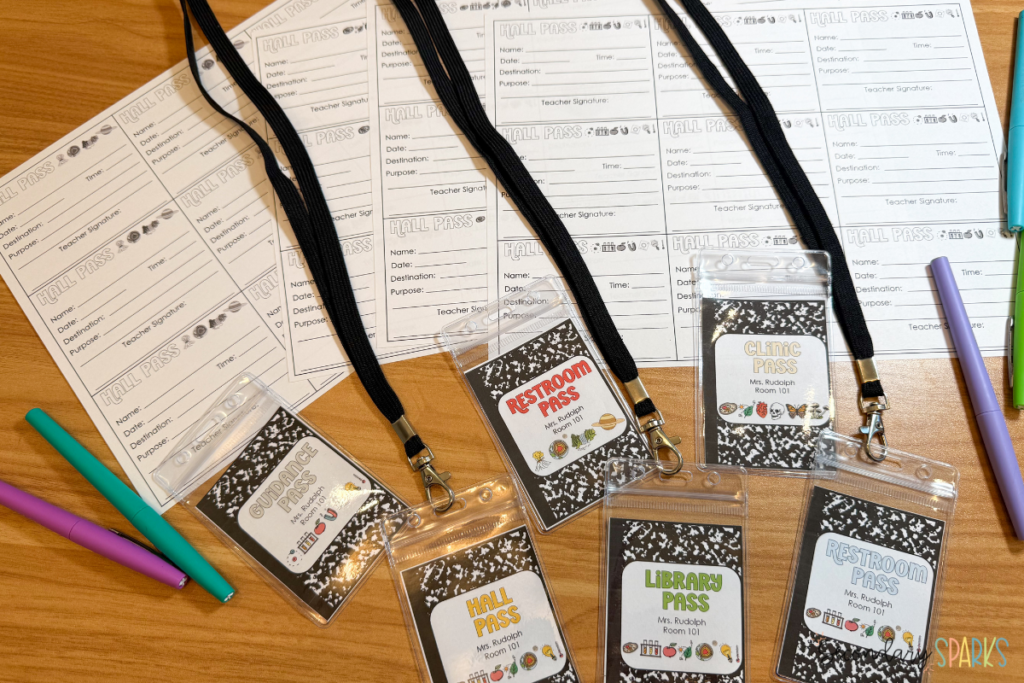
So, this year, I decided to switch to inexpensive plastic ID badge holders and they’re SO much better.
Why I Love Using Badge Holders
These badge holders are easy to clean, inexpensive to replace, durable, professional looking, and easy to customize.
I simply print the pass design, slide it into the holder, and attach a lanyard. If the insert gets damaged, I print another one. No laminator required.
It’s one of those tiny classroom upgrades that saves time and frustration all year long.
Remember: You're Managing Routines, Not Controlling Students
When it comes to hall pass ideas for middle school, it’s easy to focus on the physical pass. But that’s rarely the thing that makes the biggest difference.
The real goal is creating a classroom routine that feels predictable for everyone involved. Students know what to do. You know what to expect. And the process works without requiring constant decisions throughout the day.
When that happens, you’ll spend less time answering bathroom requests, tracking down students, or explaining procedures for the hundredth time.
Instead, you get something every middle school teacher wants more of: uninterrupted instructional time.
Because at the end of the day, the best hall pass system isn’t necessarily the prettiest one. It’s the one that quietly works in the background so you can focus on teaching science.

Leave a Reply