Description
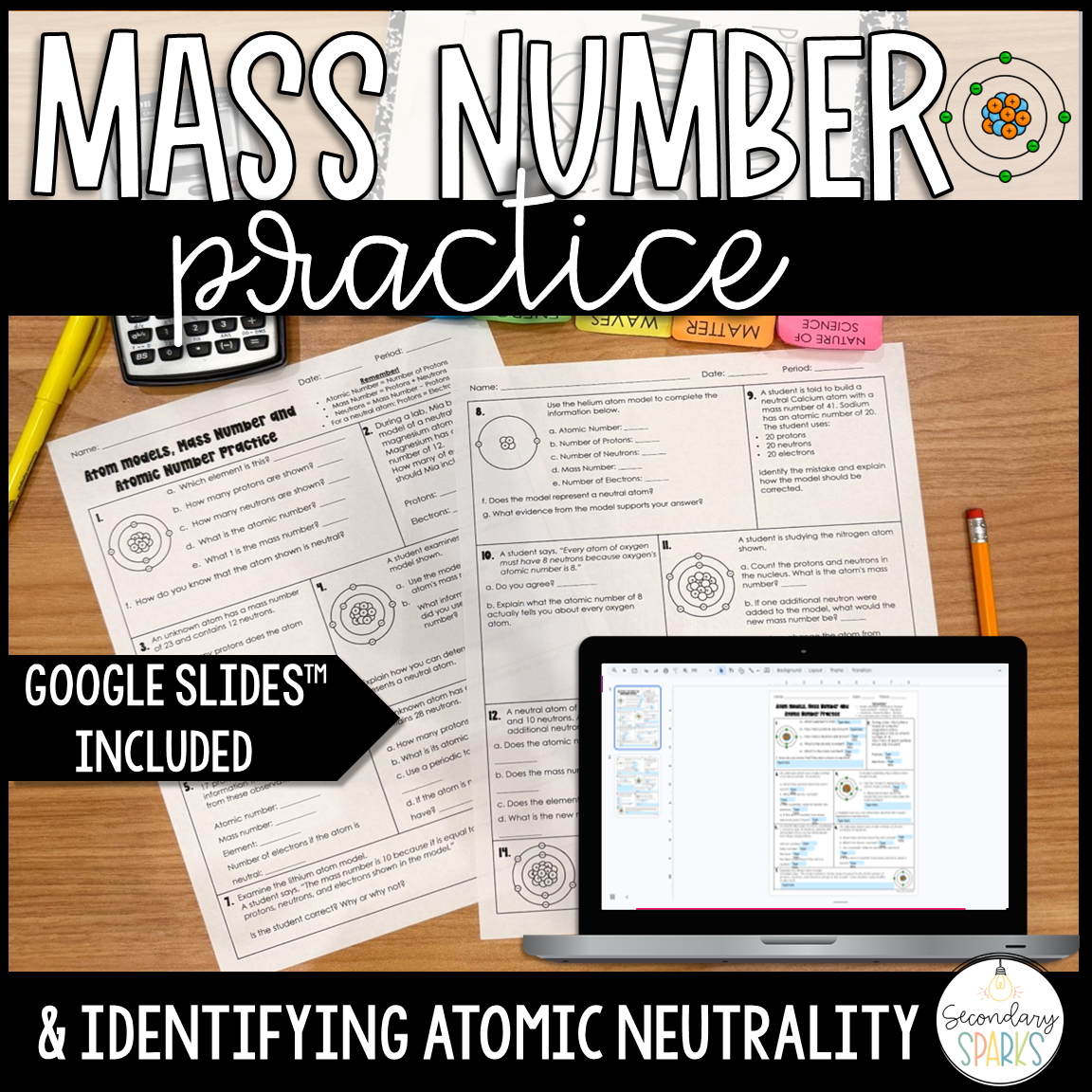
Give your students the practice they need to confidently work with atomic number, mass number, protons, neutrons, electrons, and neutral atoms!
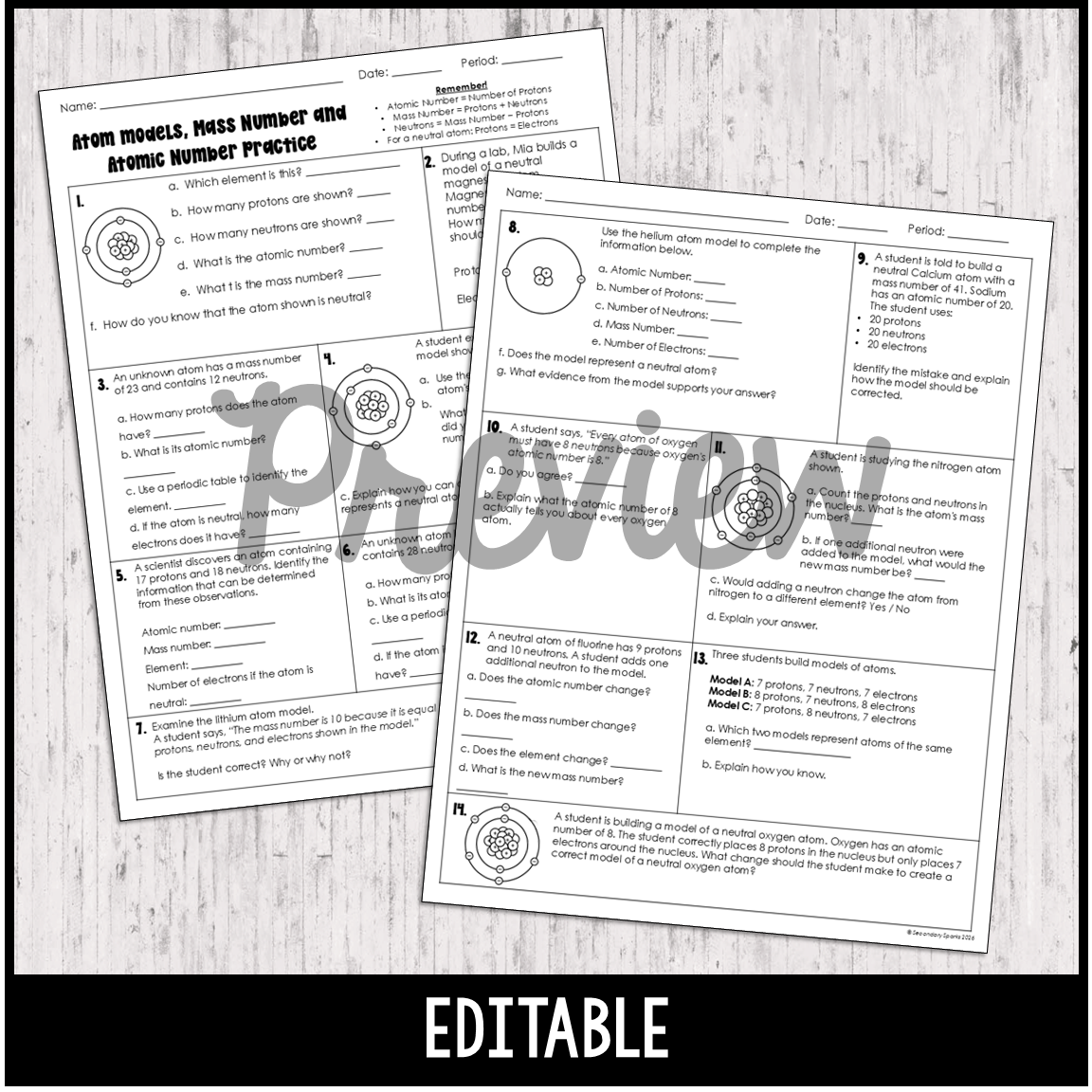
This middle school atomic structure practice goes beyond simple recall questions. Students apply what they know to scenario-based questions, atom models, error analysis, and periodic table practice. They’ll determine missing subatomic particles, calculate mass number, use atomic number to identify elements, analyze neutral atoms, and explain their reasoning.
The variety of question types makes this a great way to prepare students to apply their knowledge instead of simply memorizing that atomic number = protons.
Students will practice:
- Identifying protons, neutrons, and electrons
- Determining an element’s atomic number
- Calculating mass number
- Using mass number and neutrons to determine the number of protons
- Using atomic number to identify an element on the periodic table
- Determining the number of electrons in a neutral atom
- Explaining why an atom is neutral
- Analyzing atomic models
- Identifying and correcting errors in atom models
- Comparing atoms based on their subatomic particles
- Determining what happens when the number of neutrons changes
- Applying atomic structure concepts to real-world-style science scenarios
What’s Included?
✔ Print-and-go student practice worksheet
✔ Answer key
✔ Google Slides™ version for digital practice
✔ Editable version so you can customize questions and directions for your students
✔ Atom model clip art to provide students with visual practice
✔ Scenario-based and application questions
Please note: The resource is editable with the exception of clip art and specialty fonts, which are secured due to artist/font licensing requirements.
Make sure students have a copy of the periodic table to reference!
Easy to Use in Your Classroom
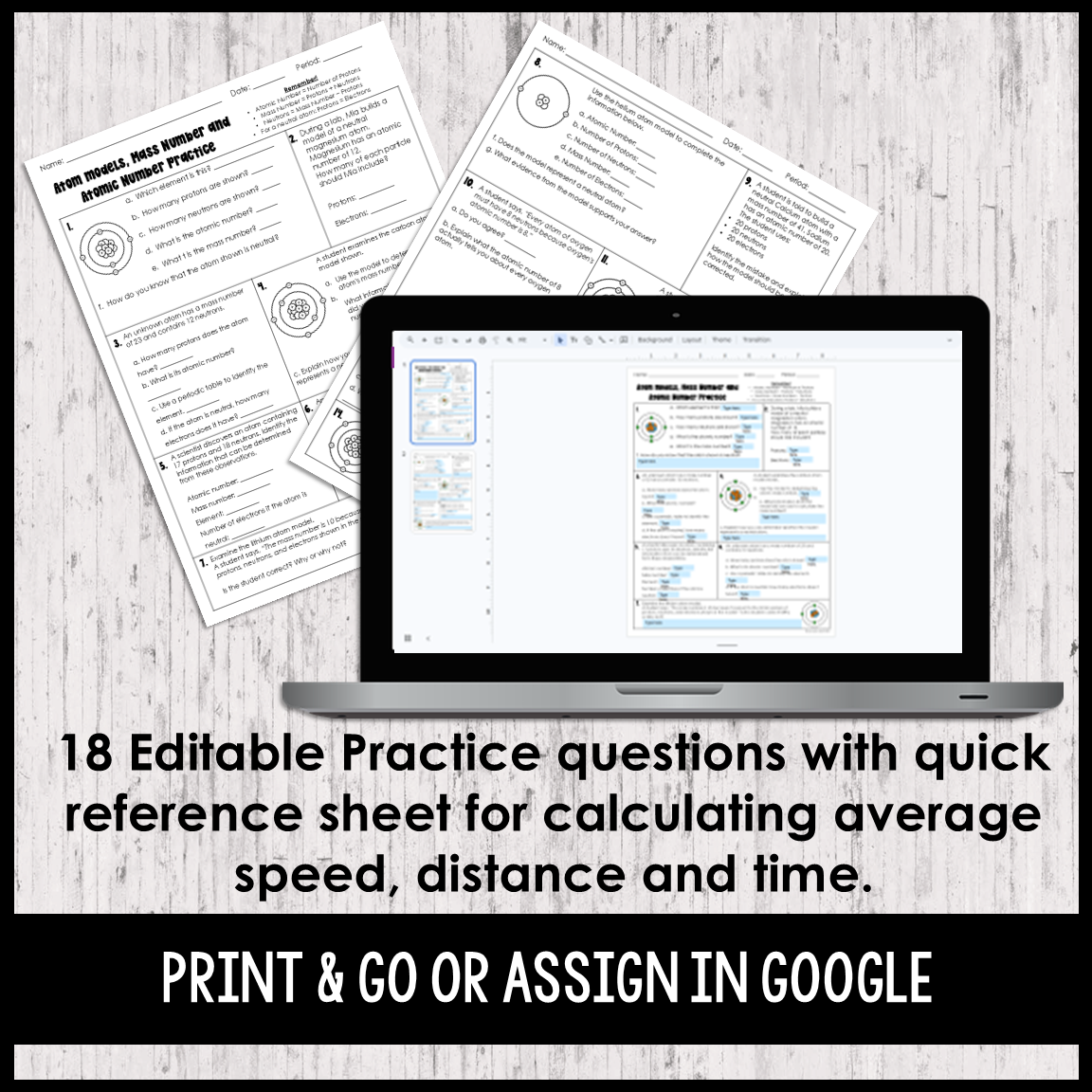
This resource was created to require minimal teacher prep. Simply print and go, or assign the included Google Slides™ version digitally.
Use it for:
- Independent practice
- Guided practice
- Partner work
- Interactive science notebooks
- Atomic structure review
- Test or quiz review
- Homework
- Small-group instruction
- Science stations
- Early finishers
- Sub plans
It is especially easy to incorporate into interactive science notebooks. Students can complete the practice directly in their notebooks or add the printable pages as a reference and review activity during an atoms and atomic theory unit.
Standards Connections
Florida Science:
SC.8.P.8.7 – Explore atomic theory by recognizing that atoms are the smallest unit of an element and are composed of subatomic particles, including electrons surrounding a nucleus containing protons and neutrons.
NGSS Connection:
MS-PS1-1 – Matter and Its Interactions
Supports PS1.A: Structure and Properties of Matter.
Perfect for Your Atoms & Atomic Theory Unit
If your students can tell you that an atom has protons, neutrons, and electrons, but start to struggle as soon as you ask them to find the mass number, work backward to determine protons, identify an unknown element, or decide whether an atom is neutral, this practice gives them the repetition and application they need.
Instead of completing the same type of problem over and over, students encounter the concepts in multiple formats, helping them build a stronger understanding of how atomic number, mass number, and subatomic particles are all connected.
Related Products:
Reviews
There are no reviews yet.