



Description
These life science stations are perfect for middle school science! Transform your middle school life science classroom with this Life Science Stations Bundle! This growing collection of interactive science station activities helps students explore life science concepts through hands-on learning, collaboration, critical thinking, scientific inquiry, and real-world applications.
Instead of relying on another worksheet or lecture, students rotate through a variety of engaging stations that challenge them to observe, experiment, create, analyze, write, research, and demonstrate their understanding of each topic. Every station is designed to keep students actively involved while reinforcing important life science standards.
Each station takes approximately 6–10 minutes, making them perfect for a single class period, block schedule, review day, or multiple-day activity.
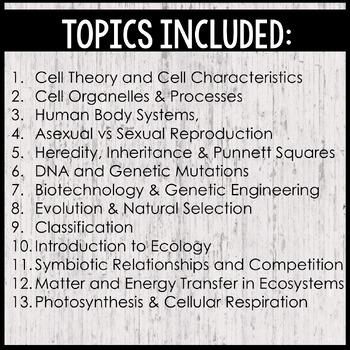
Topics Included
✔ Cell Theory & Cell Characteristics
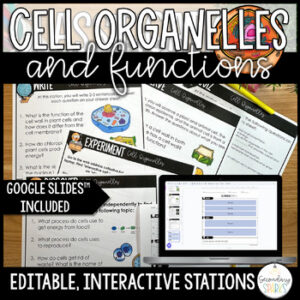
✔ Cell Organelles & Cell Processes
✔ Human Body Systems
✔ Asexual vs. Sexual Reproduction
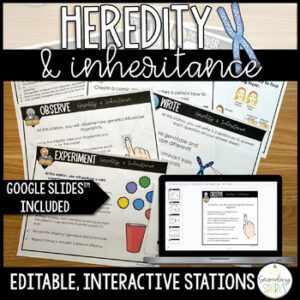
✔ Heredity, Inheritance & Punnett Squares
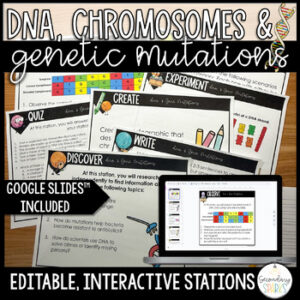
✔ DNA & Genetic Mutations
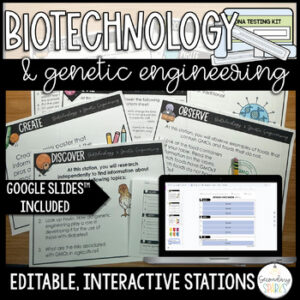
✔ Biotechnology & Genetic Engineering
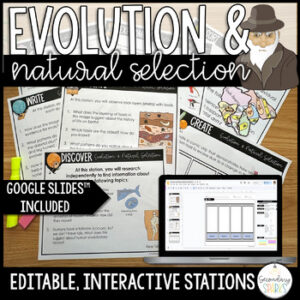
✔ Evolution & Natural Selection
✔ Classification
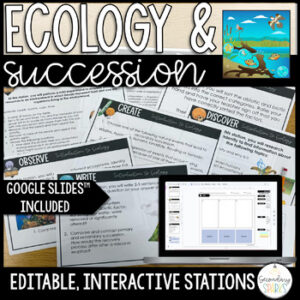
✔ Introduction to Ecology
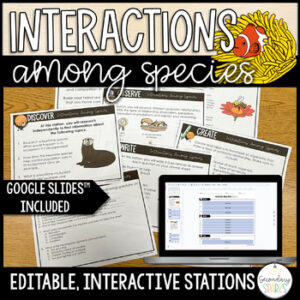
✔ Symbiotic Relationships & Competition
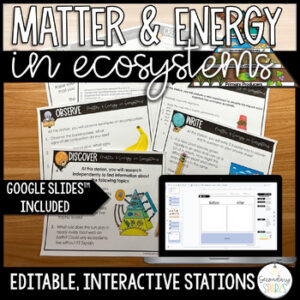
✔ Matter & Energy Transfer in Ecosystems
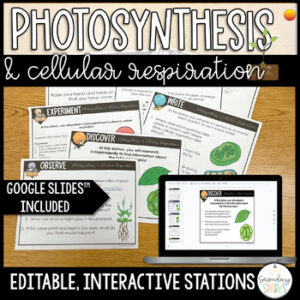
✔ Photosynthesis & Cellular Respiration
Every Stations Activity Includes
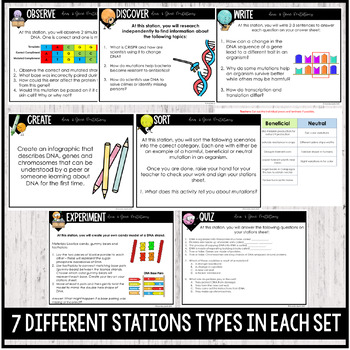
Each resource contains 7 different station types that encourage students to engage with the content in multiple ways.
Observe Station
Students observe demonstrations, models, images, or mini-investigations to explain scientific phenomena.
Create Station
Students draw diagrams, comics, infographics, models, or other visual representations to demonstrate understanding.
Write Station
Students answer higher-order short response questions and explain scientific concepts using evidence.
Sort Station
Students classify, organize, label, or match diagrams, vocabulary, scenarios, or processes.
Experiment Station
Students complete a quick hands-on investigation or mini lab before answering analysis questions.
Quiz Station
Students complete a short formative assessment to check their understanding of the topic.
Discover Station
Students research how science concepts connect to real-world situations, current events, or careers.
(Additional station activities and formats may vary by topic.)
What’s Included?
- Complete printable station activities
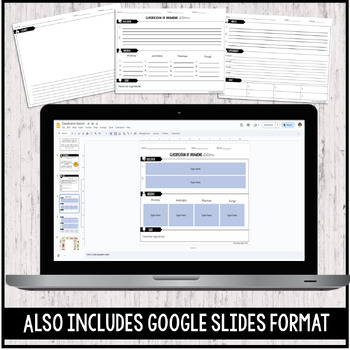
- Google Slides™ digital version
- Text-editable files so you can customize questions and directions
- Student recording sheets
- Teacher answer keys
- Low-prep classroom setup
- Station signs and directions
- Student answer booklet format that can be folded and added directly into interactive science notebooks
Who Can Use Science Stations?
These stations are perfect for:
- Middle school science teachers
- First-year science teachers looking for ready-to-use lessons
- Veteran teachers wanting to increase student engagement
- NGSS, TEKS, and Florida standards-based classrooms
- Whole-class instruction
- Small group rotations
- Cooperative learning groups
- Independent learning
- Substitute plans
- Intervention groups
- Enrichment activities
- Early finishers
- Science review days
- Homeschool science instruction
When Are Science Stations Good to Use?
Science stations are incredibly flexible and can be used throughout the entire school year.
They’re perfect for:
- Introducing a new unit
- Reinforcing difficult concepts
- Reviewing before quizzes and tests
- Interactive notebook activities
- Lab days
- Assessment review
- End-of-unit practice
- Student-centered learning days
- Emergency sub plans
- After standardized testing
- Spiral review throughout the year
- Days when students need movement and collaboration
Benefits of Stations in Middle School Science
Science stations help transform students from passive learners into active participants.
Students have opportunities to:
- Practice multiple science skills instead of completing repetitive worksheets.
- Move around the classroom, increasing engagement and focus.
- Collaborate with peers while discussing scientific ideas.
- Build critical thinking and problem-solving skills.
- Experience a variety of learning styles during a single lesson.
- Strengthen reading, writing, observation, and analysis skills.
- Practice scientific inquiry through investigations and real-world applications.
- Receive frequent opportunities for formative assessment.
- Stay actively engaged with timed station rotations.
- Develop independence and confidence while working through different tasks.
Whether you’re introducing a brand-new concept, reviewing for an assessment, or simply looking for a more engaging way to teach life science, this bundle provides everything you need to keep students learning, moving, and thinking like scientists.
Reviews
There are no reviews yet.