If you’ve ever graded a lab and thought, “My students got the right answer, but they can’t explain why it’s right…” you’re definitely not alone. One of the biggest challenges of teaching CER in middle school science is helping students move beyond simply stating an answer and into actually explaining their thinking.
Students often understand what happened during an investigation, but putting that understanding into words can feel much harder.
The good news? CER doesn’t have to be complicated. In fact, when students practice it consistently, it becomes one of the strongest tools for developing scientific thinking and communication skills.
Whether you’re brand new to teaching CER or looking for ways to make it more effective in your classroom, I’ll walk you through exactly what students need to know and how to help them succeed.
What Is CER in Middle School Science?
CER stands for Claim, Evidence, and Reasoning.
This framework helps students answer scientific questions by supporting their ideas with data and explaining the science behind their conclusions. Instead of simply giving an answer, students learn how to think like scientists by defending their conclusions with evidence and logical reasoning.
Let’s break down each component.
Claim
A claim is a statement that answers the question or problem.
The claim should be:
- Clear
- Concise
- Directly connected to the question
- Based on the investigation or information provided
One mistake I see all the time is students trying to include their entire explanation in the claim. They want to tell you everything they know right away.
Instead, remind students that the claim is simply the answer.
For example:
- Question: Which surface created the most friction?
- Claim: The carpet created the most friction.
That’s it. Short and simple.
Evidence
The evidence is the scientific data, observations, or information that supports the claim.
Evidence can come from many different sources, including:
- Lab data
- Graphs and tables
- Observations
- Reading passages
- Models or diagrams
- Provided scientific information
One of the most important lessons students need to learn is that not all evidence is equally useful. Just because data exists doesn’t mean it belongs in their CER response.
Students should choose evidence that directly supports their specific claim.
Reasoning
The reasoning explains why the evidence supports the claim. This is where students connect their evidence to scientific concepts they have learned.
For many middle school students, reasoning is the hardest part of the entire process. They often know what happened. They can even identify the evidence. However, explaining why the evidence matters requires deeper thinking.
Reasoning answers questions like:
- Why does this data support the claim?
- What scientific concept explains the results?
- How does the evidence connect to what we learned?
Once students understand that reasoning is the bridge between the evidence and the claim, their responses become much stronger.
Why Middle School Students Struggle With CER
When teachers first introduce CER in middle school science, students often hit several common roadblocks.
First, many students confuse evidence and reasoning. They may provide a piece of data and assume their explanation is complete. In reality, they have only supplied evidence.
Next, students frequently repeat their claim instead of explaining it.
For example:
Claim: The carpet created the most friction.
Reasoning: The carpet created the most friction because it created the most friction.
Technically, they wrote something. Scientifically, they didn’t explain anything.
Students also tend to:
- Include data without explaining why it matters
- Struggle to determine which evidence is relevant
- Assume the teacher already understands their thinking
- Avoid explaining their ideas in writing
- Lack experience defending their conclusions
The truth is that CER is a skill. Like any skill, students need regular practice before it feels natural.
How to Introduce CER In Middle School Science
One of the biggest mistakes teachers make is jumping straight into a complex science investigation and expecting students to write a complete CER. Instead, try building the skill gradually.
Step 1: Start With a Simple, Non-Science Example
Before students apply CER to science, help them understand the structure using something familiar.
For example, ask: Which restaurant should our class choose for a celebration?
Students will instantly have opinions about this question.
Their CER might look like this:
Claim: We should go to McDonald’s.
Evidence:
- Highest customer rating
- Lowest prices
- Most menu options
- Closest location
Reasoning: Because McDonald’s has high ratings, affordable prices, and many menu choices, it would satisfy the greatest number of students while keeping costs reasonable.
Students quickly understand how evidence supports a decision.
Once they understand the framework, transitioning to science becomes much easier.
Step 2: Model a CER Together
Next, try completing a CER as a class. Give every student the same question and the same data.
Then walk through the process together:
- Write the claim
- Identify possible evidence
- Discuss which evidence is strongest
- Connect the evidence to scientific concepts
- Write the reasoning
Most importantly, think aloud while writing. Students need to hear your decision-making process. Those moments teach students how scientists evaluate evidence.
Step 3: Teach Each Part Separately
Students do not need to master all three parts immediately.
Instead:
- Practice writing claims first
- Practice identifying strong and weak evidence
- Spend extra time developing reasoning
- Gradually combine the pieces
This approach prevents students from becoming overwhelmed and allows them to build confidence.
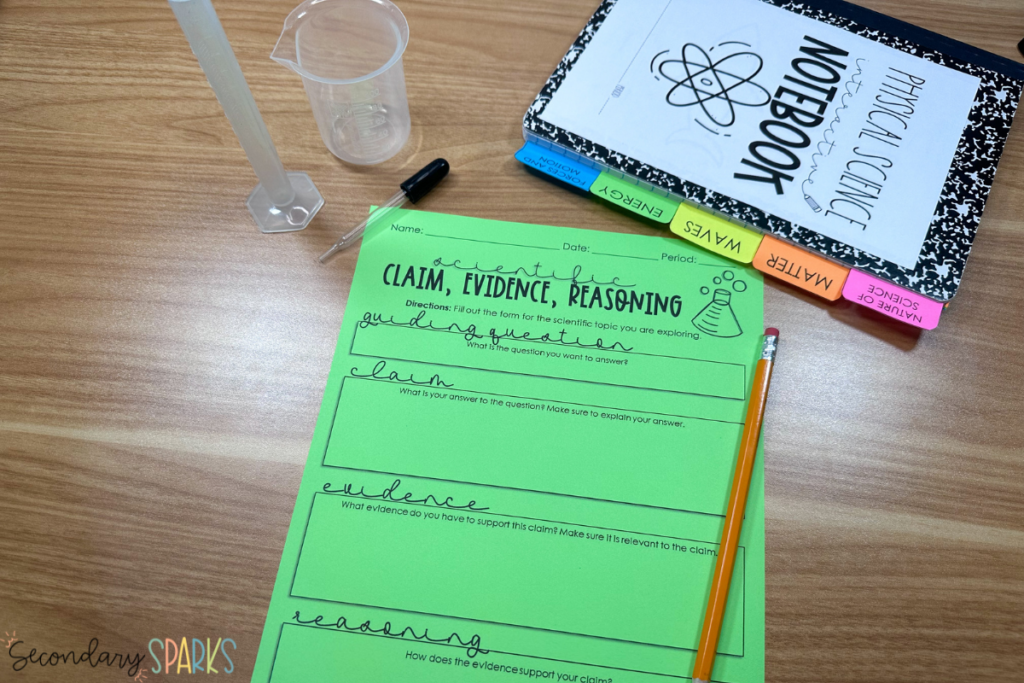
Step 4: Give Students a CER Template
When students are first learning, structure is your friend.
Provide a template with designated sections for:
- Claim
- Evidence
- Reasoning
You can also include guiding questions and sentence starters.
As students become more confident, gradually remove the scaffolds. The goal is independence, but students often need support before they can get there.
CER Sentence Starters for Middle School Science
Sentence starters are especially helpful during the early stages of learning. Over time, students typically begin using these structures naturally and no longer need the prompts.
Claim
- The evidence shows that…
- I conclude that…
- Based on the investigation…
Evidence
- The data shows…
- According to our results…
- During the investigation, we observed…
- One piece of evidence that supports this claim is…
Reasoning
- This evidence supports my claim because…
- Scientifically, this makes sense because…
- We learned that…
- This is important because…
- Therefore, the evidence demonstrates that…
Try Using CER In Middle School Science Labs
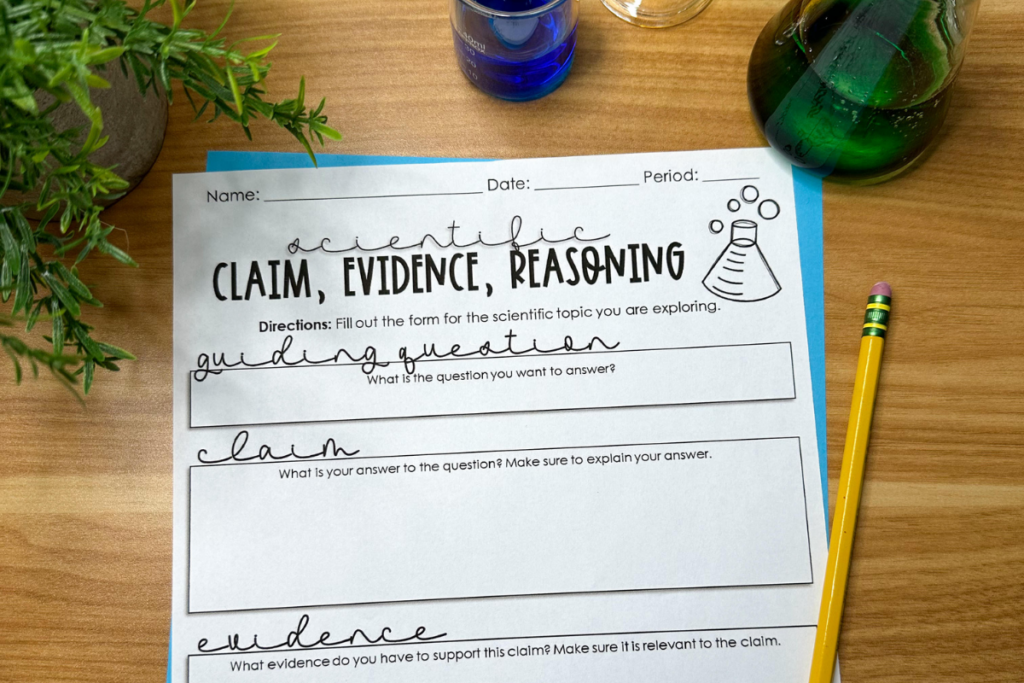
Once students understand the structure, CER becomes an excellent replacement for traditional conclusion questions.
Instead of asking students to answer a long list of prompts, ask them to complete one focused CER.
During science labs, encourage students to:
- Reference actual data from the investigation
- Use measurements and observations
- Connect their reasoning to science vocabulary
- Explain scientific concepts
- Support every claim with evidence
Most importantly, use the same format consistently throughout the year. Students thrive on routines.
When the CER structure remains familiar, students can spend less energy figuring out what to do and more energy focusing on their scientific thinking.
An Easy Middle School Science CER Example
One of the best ways to teach CER in middle school science is through simple examples that students can easily follow.
Try this friction lab when practicing CER in Middle School Science
Question: Which surface creates the most friction?
Claim: The carpet created the most friction.
Evidence: The object traveled 32 cm on the carpet, compared with 75 cm on the tile and 61 cm on the wood.
Reasoning: Friction is a force that opposes motion between two surfaces. The object traveled the shortest distance on the carpet, showing that the carpet produced more resistance to its motion. Therefore, the data supports the claim that the carpet created the most friction.
Notice how the reasoning doesn’t simply repeat the evidence. Instead, it explains the science behind the results.
That’s the piece students need the most practice with.
Other Ways to Practice CER In Middle School Science Without Doing a Full Lab
The good news is that students don’t need a formal investigation every time they practice CER. In fact, short and simple activities often work best.
Here are some easy options:
- Analyze a graph
- Interpret a data table
- Examine a photograph or scientific image
- Watch a quick demonstration
- Read a short science passage
- Analyze a fictional experiment
- Compare two scientific models
- Complete a CER exit ticket
- Find evidence that supports a given claim
- Determine which claim matches a set of evidence
These activities take only a few minutes and provide frequent opportunities for practice. The more students practice explaining their thinking, the stronger their CER responses become.
Common CER Mistakes and How to Fix Them
Even after lots of practice, students will continue making some predictable mistakes.
The good news is that each one has a simple solution.
Mistake #1: Students Repeat the Claim as Their Reasoning
Students often write reasoning that simply restates the claim.
Fix: Require students to include at least one scientific concept or vocabulary word in their reasoning.
This immediately pushes their thinking deeper.
Mistake #2: Students Give Evidence Without Data
Sometimes students write vague evidence such as: “The results support my claim.”
That’s not evidence.
Fix: Encourage students to include specific measurements, observations, or information from the investigation. The more specific the evidence, the stronger the CER.
Mistake #3: Students Include Every Piece of Data
Many students think more evidence automatically means a better response. As a result, they copy every number from a data table.
Fix: Teach students to select the strongest and most relevant evidence.
Scientists don’t use every piece of information. They choose the evidence that best supports their conclusion.
Mistake #4: Students Write One Giant Paragraph
When students are first learning CER, organization matters. If everything is mixed together, it’s difficult for both students and teachers to identify what belongs where.
Fix: Keep Claim, Evidence, and Reasoning separated while students learn the structure.
Eventually, students can combine the pieces into more sophisticated scientific writing.
Mistake #5: Students Struggle With Reasoning
This is probably the most common challenge teachers face. Students know the answer. They know the evidence. They just don’t know how to connect the two.
Fix: Ask guiding questions such as:
- Why does this evidence support your claim?
- What science concept explains these results?
- What does this data tell us?
- How does this connect to what we learned?
Those simple prompts often unlock the thinking students need.
Teaching CER can feel challenging at first, especially when students are learning how to explain their thinking rather than simply provide answers.
However, consistent practice makes a huge difference.
Start small. Model often. Use sentence starters when needed. Most importantly, give students frequent opportunities to explain their reasoning.
Over time, you’ll notice something exciting happen. Students begin asking better questions, making stronger observations, and supporting their ideas with confidence.
And that’s really the goal of CER in middle school science. To teach students how to think, communicate, and argue from evidence like real scientists.
Once students develop those skills, they’ll carry them far beyond your science classroom.
Leave a Reply