
Description
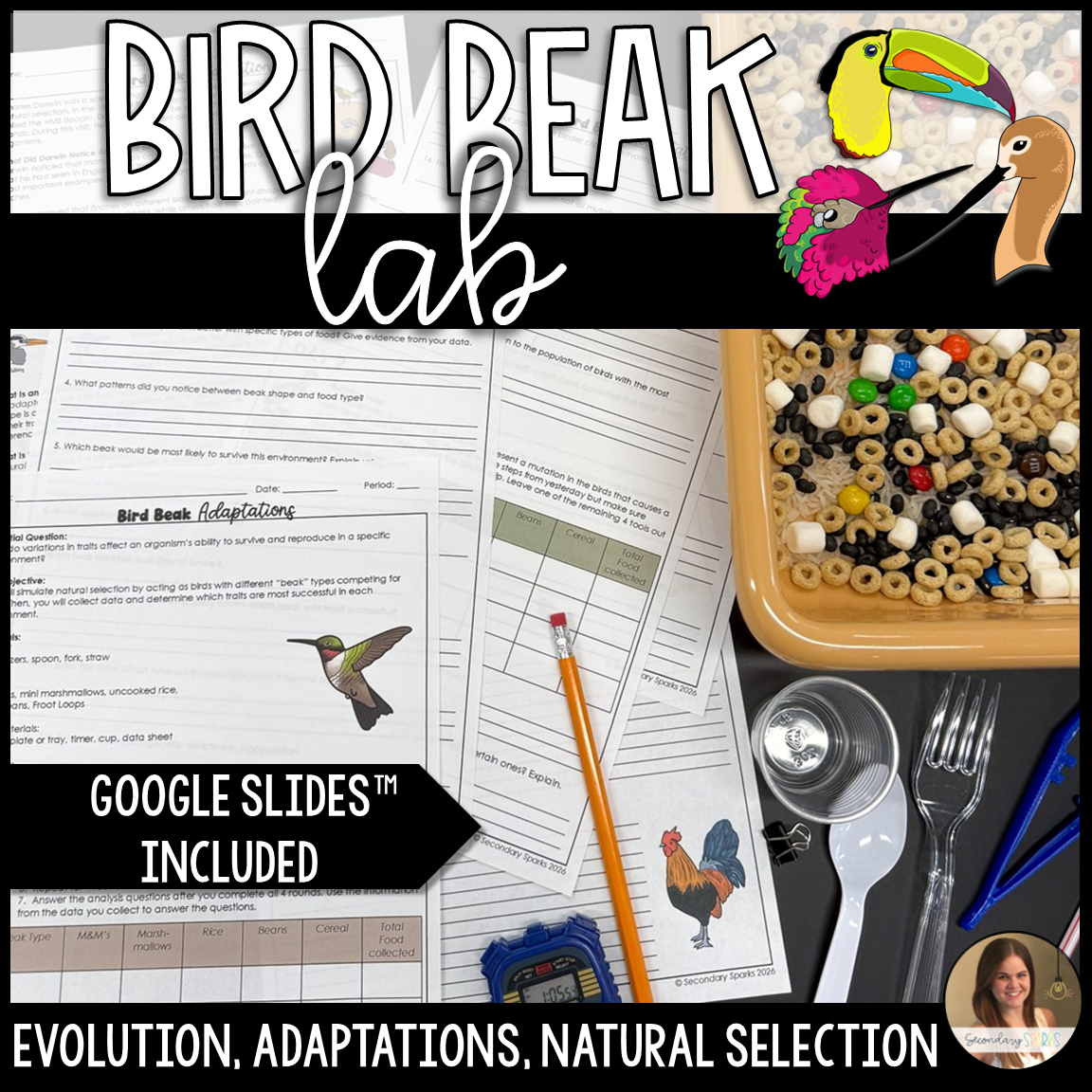
Looking for a hands-on natural selection lab that actually gets your students excited about evolution? This middle school science evolution activity is a student-favorite that brings adaptations, genetic variation, and natural selection to life through an engaging bird beak simulation.
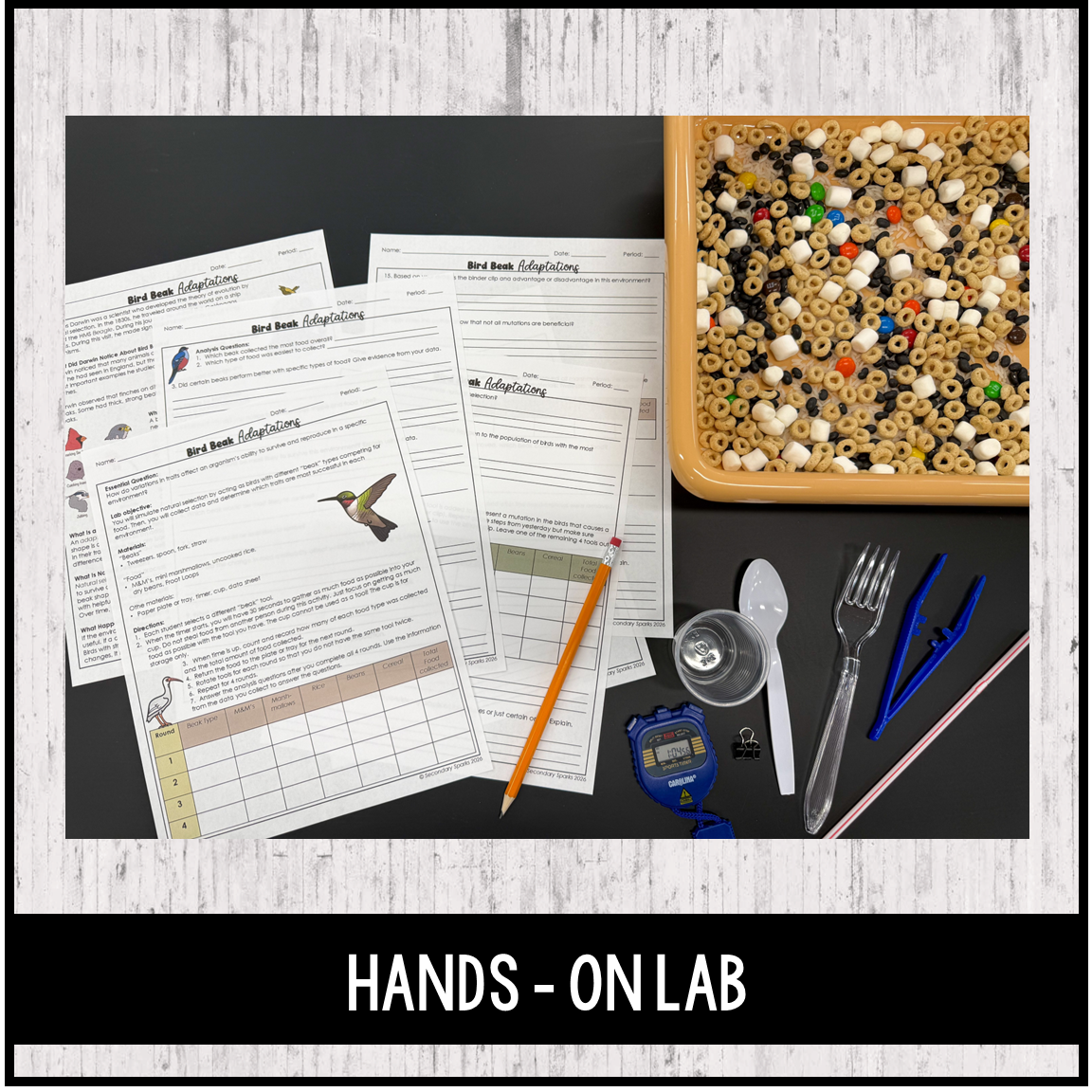
In this interactive science lab, students take on the role of birds competing for food using different “beak” tools (tweezers, spoons, forks, straws, and clothespins). As they collect and analyze data, students quickly discover how variations in traits impact survival and reproduction in specific environments, making this the perfect natural selection simulation for your classroom.
WHY THIS EVOLUTION LAB WORKS
This is a highly engaging, inquiry-based science lab where students actively explore:
- Natural selection and survival of the fittest
- Adaptations and environmental interactions
- Genetic variation within populations
- Mutation and its impact on survival
- Extinction due to environmental change
Students rotate through different “beaks” and compete to collect various food types (M&M’s, beans, rice, cereal, marshmallows), allowing them to visually and physically connect to the concept of Darwin’s finches and how organisms adapt over time.
WHAT STUDENTS WILL DO
In this hands-on middle school science lab, students will:
- Participate in a natural selection simulation using bird beak tools
- Collect and record quantitative data across multiple rounds
- Analyze which traits are most successful in different environments
- Identify patterns between beak structure and food type
- Explore a mutation scenario using a new “beak” tool
- Investigate an environmental change scenario and discuss extinction
- Complete analysis questions using evidence from their data
- Write a Claim-Evidence-Reasoning (CER) explanation to demonstrate understanding
This adaptations activity for middle school science is ideal for:
- Evolution units
- Natural selection lessons
- Adaptations and survival of organisms
- NGSS-aligned instruction
- Science stations or rotations
- Review or reinforcement
WHAT’S INCLUDED?
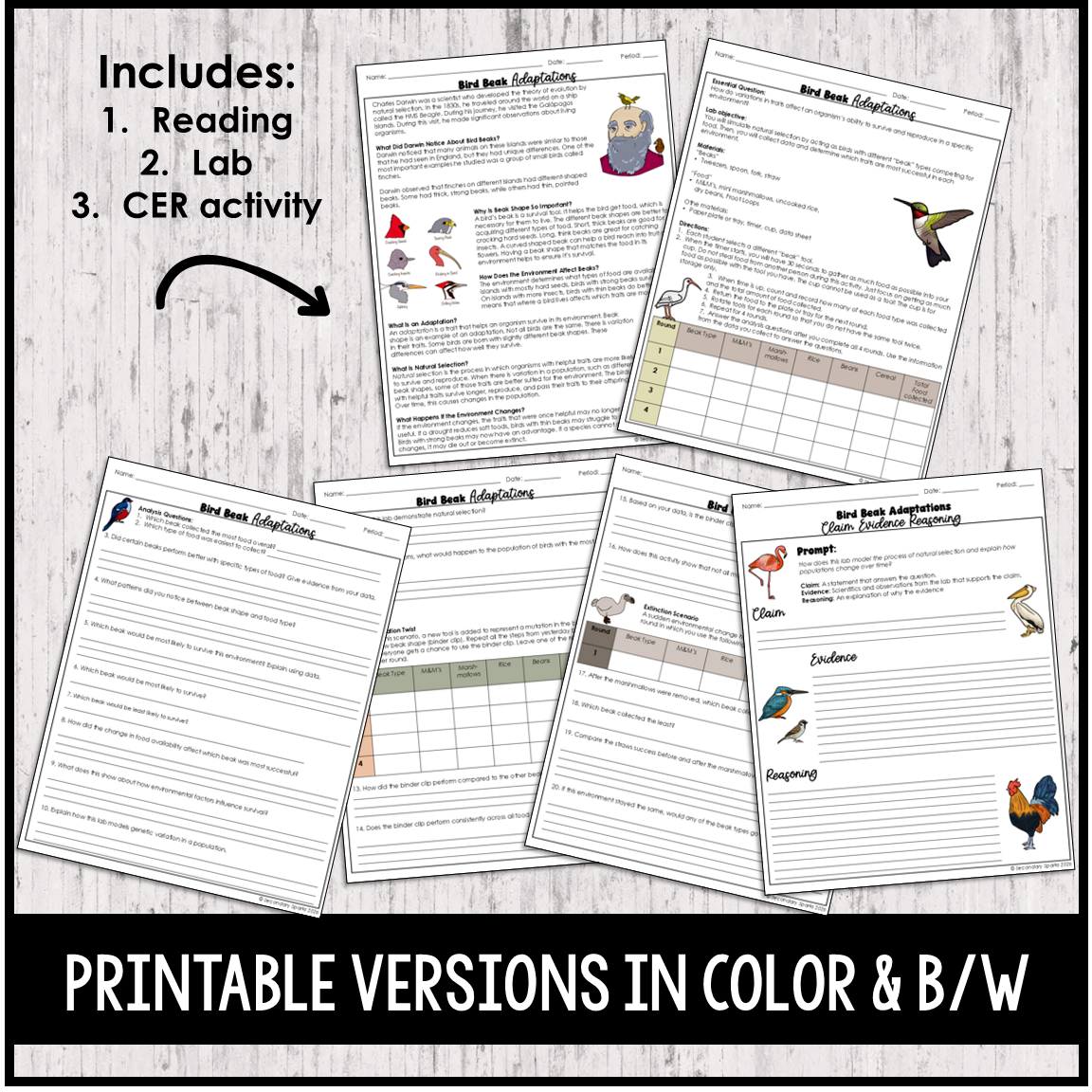
✔️ Reading about Charles Darwin and Finch Beaks
✔️ Printable lab (color + black & white versions)
✔️ Student data tables and recording sheets
✔️ Higher-level analysis questions
✔️ Mutation simulation extension
✔️ Extinction scenario activity
✔️ CER (Claim-Evidence-Reasoning) writing page
✔️ Answer key included
✔️ Fully text-editable files (clip art is not editable and cannot be removed)
✔️ Digital Google Slides version for paperless classrooms
STANDARDS ALIGNMENT
This NGSS-aligned evolution lab supports:
- MS-LS4-6: Use mathematical representations to support explanations of how natural selection leads to changes in traits over time
- MS-LS4-4: Construct explanations based on evidence about how genetic variations affect survival and reproduction
- Florida Standard SC.7.L.15.2: Explore the scientific theory of evolution by recognizing how genetic variation and environmental factors contribute to natural selection and the diversity of organisms
WHY TEACHERS AND STUDENTS LOVE THIS ACTIVITY
⭐ Low prep, high engagement
⭐ Uses simple, inexpensive materials (utensils + food)
⭐ Encourages student-centered, inquiry-based learning
⭐ Builds strong connections to real-world science concepts
⭐ Promotes critical thinking, data analysis, and scientific reasoning
⭐ Works great for all learners with built-in differentiation
Check out other Evolution and Natural Selection resources:
Evolution and Natural Selection Lesson Guided Notes and Assessment
Evolution and Natural Selection Google Slides and Print Activities
Reviews
There are no reviews yet.